Embodied artificial intelligence and new ways to deal with smog – sounds intriguing, right? But when you read deeper, you get: entropy of the attention map, machine vision and individual cryptography or remote sensing of nitrogen oxide emissions... The stairs begin... In fact, you can see the gap between the complexity of the concepts used by scientists and the degree of their understanding by people trying to understand their work. At Profeina, we learned how to build a communication bridge over it, i.e. how to create PR for science.
If you ask any of the AI models generating graphics for a photo of a scientist at work, most likely within a minute you will see a bearded, middle-aged man wearing a white coat and glasses, sitting alone in a small room with test tubes containing colorful liquids. Very stereotypical, but artificial intelligence didn't invent it itself. She only modeled herself on the most common representations of scientists that we had previously posted on the Internet.
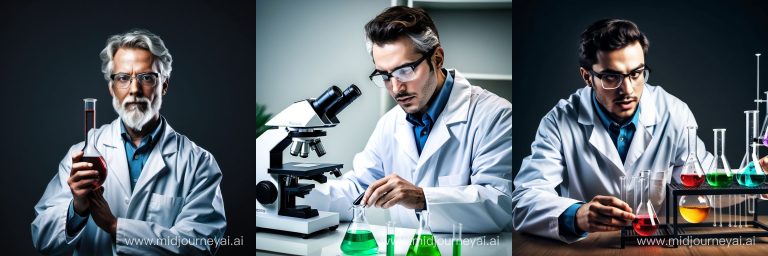
Our ideas about working in science often come from science fiction movies, where a team of scientists who look like this make a breakthrough discovery that turns the world upside down. And that's where the problems usually start...
Reality is often far from these visions. Real scientists do not have to be men. Or chemists in lab coats. They work with data and stare at a computer screen more often than with new substances. And most of their discoveries are not a Copernican revolution, but just another small brick in the huge edifice of science. And to understand their contribution to the development of science - you would need to study their discipline for several years...
Why do researchers need scientific PR?
In one respect, scientific stereotypes sometimes come close to reality. Many researchers actually feel best in the privacy of their own office and among their colleagues. Meanwhile, their work is not only about research. Popularization of science is also important. Going beyond the walls of the institute. Participation in symposia, conferences and competitions. Publications in reputable journals. And finally, obtaining grants for further research projects. Moreover, it is useful to take care of scientific PR, i.e. talk about the effects of your work, even when they are not - really or apparently - groundbreaking.
The solution to this is not to extract a lot of data from publications and use technical terms. Do not assume that the facts will prove themselves and that thanks to them the popularization of science will happen on its own. This approach - as scientists have shown - may even have the opposite effect.
So how can Profeina help in such situations?
AI explains the world (of science) to us
Once upon a time, i.e. before the era of artificial intelligence, proper scientific PR was preceded by tedious research into the topic. If the report or research paper contained a lot of expert terminology, almost every definition that was not fully understood had to be checked in Wikipedia and more professional sources. It was also a good practice to look for videos on proven YouTube channels that popularize science.
We still do all this today. However, AI now turns out to be of some help in understanding science, but not the one that generates stereotypical graphics, but large language models that process text. For example, the popular ChatGPT.
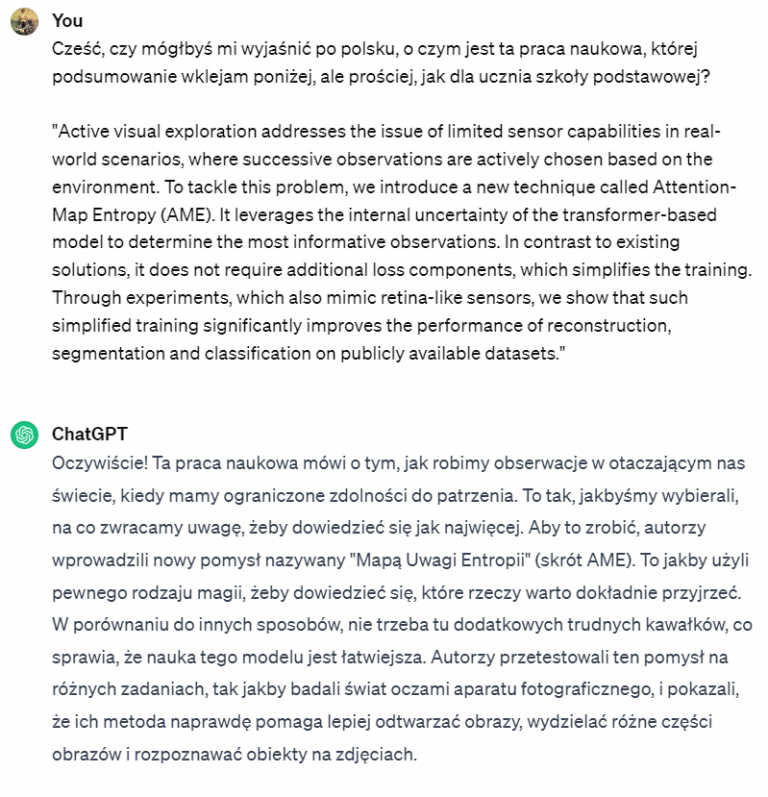
Each scientific article has an abstract, i.e. a summary of the actual text. Research reports have a similar executive summary at the beginning. As a rule, they should contain the main thesis of the publication, as well as as many keywords as possible, so that the reader can more easily understand what is being discussed next. Unfortunately, such an accumulation of industry jargon often discourages laypeople. Sometimes you can give up on the second sentence.
Such introductory text can be pasted into ChatGPT with the request "explain this to me like you would an elementary school student". And he actually does it. Maybe a fourth-grader wouldn't always be able to understand what the chat returns, but the effect is more digestible for a person with average knowledge. If it goes too well, the chat simplifies the text too much and there is still a conceptual gap, you can try with a "high school student" - then we will get the popularization of science for intermediate students.
It will not be ready-made material to be posted on a blog or sent to journalists. However, this is a very good starting point for doing scientific PR and deciding what we want to talk about when presenting the work of scientists.
Interview with a scientist in 13 simple steps
To do this, however, you have to dig deeper, but smarter. We do it with questions. We send them directly to those interested or look for answers in the materials we already have.
1. Context
Is this discipline new? Where did it come from? Who invented or popularized it? What attracts researchers to it and distinguishes it from others? What would be its breakthrough and when can we expect it?
2. Place in the world
Are these studies unique in Poland / Europe / the world? Or maybe Poland is a leader here on an international scale? If Poland is not the leader, who is leading in the technological race and what is our place? Is it done differently in Poland than elsewhere?
3. Kitchen – it can be more interesting there than in the living room
E.g. "What does “feeding” a machine learning model with data actually look like? Where do they come from and how is it then verified that the model has acquired them?”
4. Reason
What was it that we were missing in the world that made you want to discover/discover something new?
5. Application
What does it do? – so the question is a bit related to the previous one. Only here we no longer wonder what problem we are looking for a solution to, but rather what this recipe might look like.
6. So what?
The essence of science popularization. What will we be able to use the results of this study/results described in the work for in practice? How can they be implemented? What will happen next and who will benefit?
7. The future
What does the year, say 2034, look like in which the technology being researched is already operational, implemented, and the average user has access to it? What has become possible or easier than it is today? Or maybe new companies, professions, industries have been created that do not exist yet?
Here, scientists are allowed to fantasize, and if they are not willing to do it themselves, they can also put forward a bold thesis about the future and ask for it to be verified.
8. Surprises
What might be the side effects of popularizing this solution or developing it further?
9. Controversy
Are there any aspects of your research that raise objections within or outside the scientific community? What do you say to the skeptics?
10. Business
In a few years' time, do you want to commercialize your achievements yourself (e.g. by establishing a startup), or just provide them in the public domain, expecting that the market will take them up? If the latter, who and how could make the solution available to users?
11. External validation
Did your work win a competition or get accepted to a prestigious conference? Did the scientists receive a grant (if so, how much?). Or maybe a large company has invested in the project or plans to do so?
12. Timely thread
If something widely discussed has happened in the last few months that touches on the field of research, this is an opportunity to say more about it. Could this situation have been different if the people involved had the solutions you were working on?
13. “Stupid question”
E.g. "What is more difficult - training a robot to communicate like a human or teaching it to move freely around the apartment or on the street?
Think about the things that first come to a layman's mind, but scientists don't think about on a daily basis - it will be a refreshing experience for them.
Not every question will fit every case. Not every answer will contain actionable information.
But if even half of them seem interesting to your non-expert eye - choose one of the threads and place it in the title of the text describing the study. Let him set the whole narrative. Try to make the next two part of the headline or start the actual text/video/podcast with them.
Just don't forget that the message - apart from interesting facts - must contain answers to basic questions for each piece of information: Who? What? When? Where? Why? How? If you can fit it all together in the first few sentences of the lyrics or two minutes of the recording, take a break, take a deep breath and listen to what it sounds like. When the effect is OK, continue telling the story, now in a little more detail. Maintain this proportion of specifics and broader context for at least 2/3 of the material - the end may contain more difficult facts and be "for the persistent".
Popularizing science in practice: our examples
And here's how Profeina does PR for science. This is how some of the information we have prepared regarding scientific events from recent months begins:
1) “A new Polish research team wants to teach robots physics”
Robots can walk on their own legs, move objects or even dance, but they usually only do it well in the laboratory. In order for them to move efficiently around the apartment or on the street, research using artificial intelligence is needed. They will be conducted by a new research team - Physical Interaction Robotics - which was established at IDEAS NCBR, a research and development center in the field of artificial intelligence.
The word "robot" has been with us for over a hundred years. It was invented in 1920 by a Czech playwright, inspired by the Slavic "robot". The neologism was created for the needs of art in which beings resembling people performed manual work. Later fantasy creators had a similar approach - the robots they invented were usually poor at communication, but were good at physical work. When, with the development of science, we started to construct real robots, it turned out that their abilities contradicted expectations. Today, we are able to confuse a chatbot or voicebot with a real person, but we very rarely mistake a physical robot for a human.
>>> More
2) “Polish AI-controlled drones will fly to the international tournament in Abu Dhabi”
Competing in the Mohamed Bin Zayed International Robotics Challenge (MBZIRC) robotics competition at first glance resembles a sports competition, but in fact it has much more in common with scientific work. It took the Polish team almost two years to build, program and "train" a swarm of autonomous drones, and the flight technique and solving the robots' tasks will be improved for several more months before the final with the participation of the five best teams in the world, which will take place in the capital of the United Arab Emirates in February 2024. The winners of the competition will receive a prize of million, and the total prize pool is .25 million.
The Nomagic Warsaw MIMotaurs team of scientists associated with the University of Warsaw and IDEAS NCBR, a research and development center in the field of artificial intelligence, qualified for the finals of the prestigious robotics competition in the United Arab Emirates. Over the waters of the Persian Gulf, the swarm of autonomous drones they have built will face teams of the world's best designers.
>>> More
3) "Individual cryptography. Polish scientists are working on limiting the practice of sharing accounts"
A team of scientists associated with IDEAS NCBR got to the international Crypto 2023 conference thanks to a scientific paper describing the original method of "individual cryptography". This method is intended to help providers of digital content and tools who, like Netflix, regularly suffer from the difficult-to-detect illegal sharing of passwords between users from separate households.
Subscription was a concept known to magazine readers long before the advent of computers and the Internet, but it was only when it was transferred to the digital world as a subscription that the era of high-quality knowledge and entertainment available virtually anywhere on Earth began. (…)
Unfortunately, digitization often also brings huge costs of business scaling, which are difficult to cover due to the common phenomenon of granting access to produced content to third parties who have not purchased access to the content of a given category. The popular streaming service Netflix has been struggling with this for years, and according to Citygroup estimates, it would lose as much as billion annually from users who share access to it with people outside their household.
(…) The solution may be individual cryptography, a concept developed by Polish scientists.
>>> More
4) “Thanks to the clean transport zone, Warsaw may have half as much exhaust gas this decade [REPORT]”
A simulation of the impact of a clean transport zone (SCT) on air quality in Warsaw described in the new TRUE Initiative report shows that the creation of an SCT would bring quick results. By 2027, half of nitrogen oxides (NOx) would disappear, and by 2025, half of particulate matter (PM) emitted by vehicles would disappear.
Remote sensing measurements of cars driving on the streets of Warsaw, conducted by The Real Urban Emissions (TRUE) Initiative, showed that a small group of vehicles has a disproportionate share in pollutant emissions. Vehicles manufactured before 2011, which in 2026 will constitute 8%. fleet, will cause 27 percent automotive NOx emissions and 55 percent PM emissions.
>>> More
—————-
At the end – remember that figuring out the intricacies of scientific discoveries is better if you constantly observe people who do it well and are inspired by their work. Therefore, to start, observe three knowledge popularizers with whom we at Profeina had the opportunity to cooperate and whom we value.
Tomasz Rożek (Science. I like it)
Kasia Gandor
Paulina Górska (Lepszy Klimat)
Author: Grzegorz Dzięgielewski