NEW!

10 min read

Campaign for clean transport zones in Poland

A persuasive narrative and building new alliances – these two skills of the Profeina team proved key during the implementation of an almost two-year PR and advocacy campaign to popularize clean transport zones in Poland. What actions did we take and what conclusions do we have for the future?
The topic of clean transport zones (abbreviated as SCT) in Poland has not escaped polarization. Moreover, it became the arena of one of the fiercest public debates in Warsaw, Kraków, and Wrocław. A seemingly technical issue landed right in the middle of a culture war surrounding the green transformation.
This was symbolically demonstrated by the noisy and non-substantive session of the Warsaw City Council in December 2023, where councilors adopted a resolution on the implementation of the SCT. Other examples included attempts to block the citizens’ deliberation on this matter in Wrocław in the summer of 2023, as well as the legal challenge against the Kraków SCT brought to court by the Voivode of Lesser Poland and the emotions surrounding the decision he issued (January 2024).
Running an information and education campaign on a topic that is (gradually) becoming political and evokes (often justified) fears and emotions is difficult. The belief that facts speak for themselves and that this is a sufficient argument to gain social support is wrong. This prompted us to remodel the campaign from informational to more narrative, including more open communication of not only the benefits (especially health ones) but also placing clean transport zones within a broader discussion on the vision of the cities we want to live in. Importantly, we drew conclusions from the campaign on an ongoing basis and adjusted our engagement to the changing political environment and social moods.
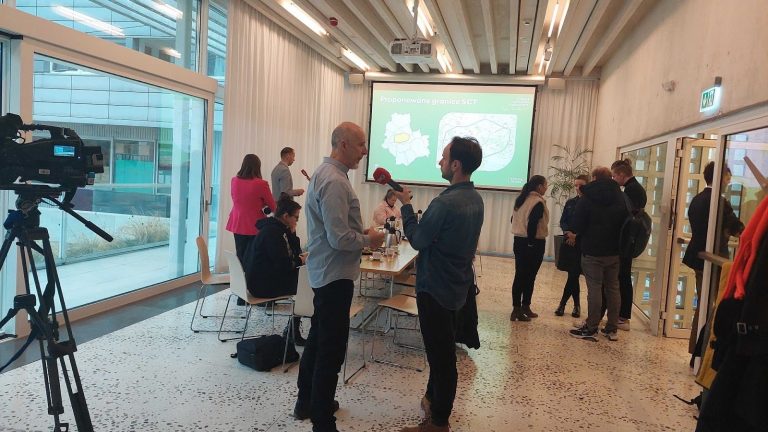
Meeting of the Warsaw City Hall with the media and engaged entities – announcement of the intention to introduce the SCT

TL;DR, or a brief overview of the campaign

Campaign name
  • Running an information hub on clean transport zones
Client (grantor)
  • Clean Air Fund – a global philanthropic institution supporting projects for clean air
Duration
  • May 2022 – March 2024 (and ongoing)
Goal
  • Supporting local authorities and officials in creating clean transport zones in Polish cities by building social support for clean transport and projects improving air quality in cities.
Assumptions
  • Until recently, large cities in Poland focused on facilitating car traffic in cities, neglecting other needs of residents, including air quality.
  • We wanted to gradually accustom residents to the necessity and legitimacy of introducing clean transport zones in large cities.
  • The challenge from the beginning was the unpredictable and polarized public debate in Poland.
  • Our relationships with a range of allies (NGOs, urban activists) who could support the clean-air agenda were a major facilitator.
Results (as of March 2024)
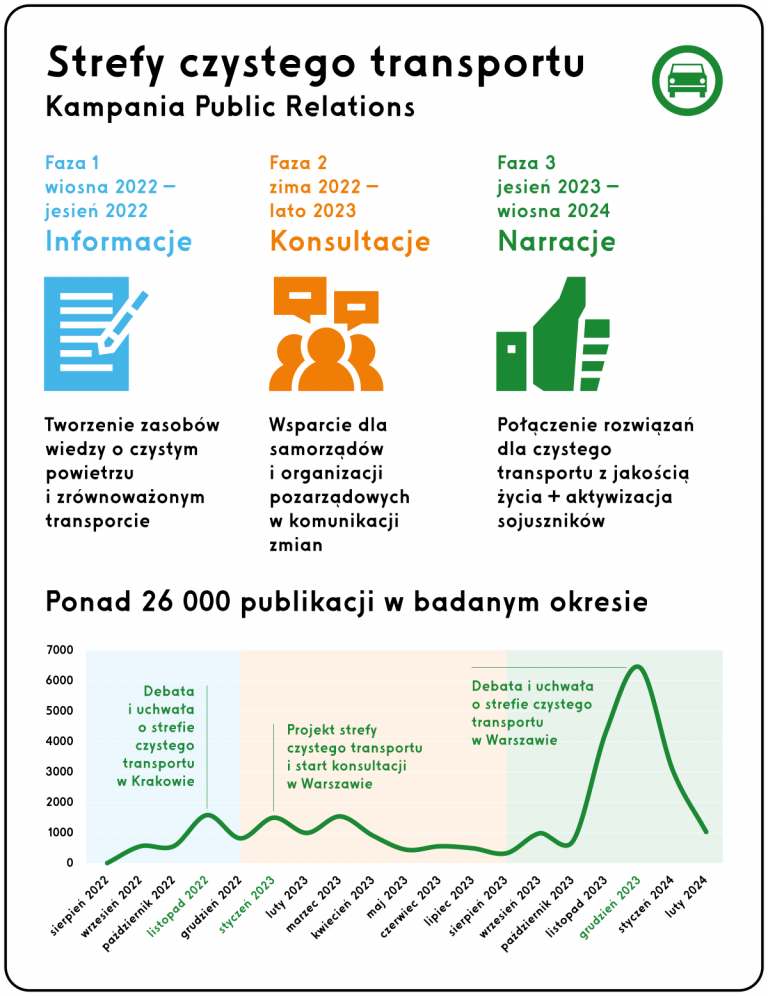
  • 26,000 + media and social media publications.
  • 1.2 billion + views of publications regarding SCT.
  • Breaking through with the topic into the mainstream – it turned from a niche issue into a fairly common (and simultaneously political) one – candidates in parliamentary and local government elections were questioned about their plans for SCT.
  • Warsaw and Kraków adopted resolutions on the creation of SCT (the implementation of the Kraków SCT was suspended by the court; a completely new project is expected in the next term of local government).
  • The SCT project in Wrocław was submitted to public consultations (the topic is expected to return in the next term).
Key activities
  • Strategic workshops for local government officials and experts on how to effectively communicate the topic of clean transport zones.
  • Production and distribution of content (texts, infographics, brochures, YouTube videos) for cooperation with journalists, opinion leaders, and influencers.
  • Developing information and fact-checking materials directed directly to residents of cities planning SCT (Warsaw, Kraków, Wrocław): close cooperation with officials and experts.
  • Popularization of results of scientific and social research on transport-related smog.
  • Communication support for several press conferences and events regarding sustainable mobility.

Detailed campaign description

Context and challenge
Since December 2021, Polish law has allowed local governments to restrict vehicle traffic based on exhaust emissions, i.e., to create clean transport zones (SCT) modeled after European cities, where the most polluting cars are not allowed into the city center.
At the same time, provincial Air Quality Programs obliged Warsaw and Kraków to establish SCTs by the end of 2024. Is three years a lot or a little for such a project? Contrary to appearances, it is not much.
Experts estimate that the implementation of the zone itself should take local authorities about 2-3 years. During this time, pioneer cities also had to plan the SCT in detail, organize public consultations, and convince councilors to adopt a resolution on the matter.
But how to consult a solution whose name means little to those outside the circle of clean-air experts, about which a number of myths exist, and where few residents of the cities where the zones are to be established fully understand how they would work?
An information campaign was needed literally “as of yesterday.”
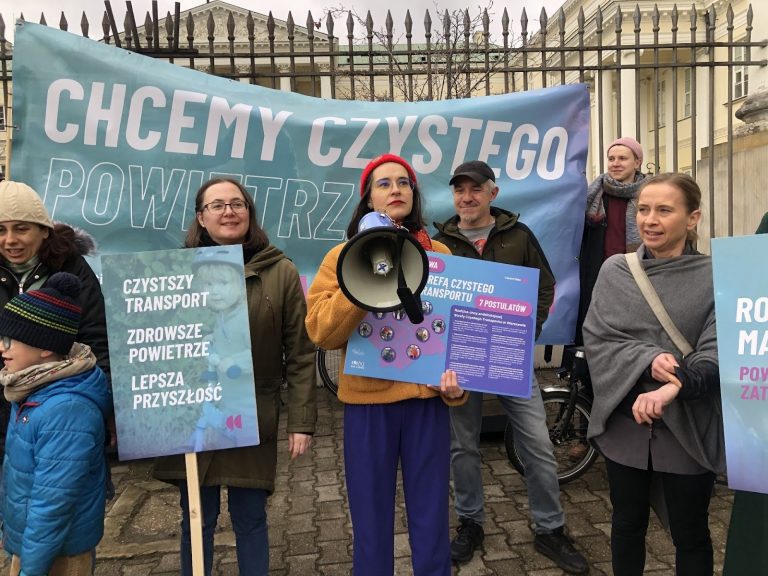
Parents presenting support for the SCT in front of the Warsaw City Hall

Actions and effects

We launched the campaign for clean transport zones in late spring 2022 as a continuation of the successful project promoting the TRUE report on real exhaust emissions in Warsaw. Our activities can be divided into three complementary stages, which we define as: information, consultations, and narratives. Although these phases sometimes overlapped, it is important to note that in each of them, we emphasized slightly different issues related to clean transport zones and utilized various PR tools.
Campaign phaseKey activitiesResults & conclusions
INFORMATION

(spring 2022 – autumn 2022)

getting to know the players involved – allies – a series of workshops and meetings to identify who has what resources, goals, and needs, and who our support could best help.

public opinion research – clarifying the starting point (scale of knowledge and support for SCT and other green urban projects).

information hub – building a website for media and officials with the most important reports, information, and data regarding SCT.

media relations & paid collaborations with opinion leaders – launch of a coordinated information campaign on clean transport zones in traditional and social media (collaborations with, among others, Kasia Gandor, Tomasz Rożek).

  • 550+ publications around the opinion research,
  • 60 press materials and 11 educational videos were created for the later part of the campaign,
  • adoption of a resolution by the Krakow City Council to create an SCT covering the entire city (resolution suspended by the administrative court at the beginning of 2024).
CONSULTATIONS

(winter 2022 – summer 2023)

PR support for Krakow, Warsaw, Wroclaw – creating information materials for residents about the planned clean transport zones (FAQs, detailed technical and substantive explanations, infographics, posters, animations) and materials for city councilors (so-called argument packs).

public consultations – substantive and communication support for teams working on SCT in Warsaw and Wroclaw to ensure as many residents as possible learned about the consultations and took part in them.

media monitoring and analysis – constant monitoring of media, social media, and the sentiment of the social debate around SCT, sharing analyses with cities and NGOs.

animating support for SCT – encouraging those involved in social initiatives to participate in public consultations on SCT and to demand ambitious transport policies.

  • 1150+ publications concerning only the public consultations in Warsaw,
  • 3000+ opinions from residents regarding the Warsaw SCT,
  • involvement of several local and green initiatives to make clean transport zones one of their areas of activity,
  • the Warsaw clean transport zone project dominated the media debate,
  • the topic moving beyond the bubble and the fairly complicated SCT requirements fueled misinformation – clean transport zones became part of the growing polarization around green issues.
NARRATIVES

(autumn 2023 – spring 2024)

soft actions for air
1) anti-smog radio spot parodying a cough syrup advertisement, 2) "What does your street breathe" mini-campaign raising awareness of the health consequences of daily smog inhalation, 3) popularization of scientific research results regarding pollutant emissions (including from ICCT, ECAC, and doctors from the Polish Smog project), 4) podcast series with eco-educator Paulina Górska, featuring experts on green urban policies.

facts and myths – communication and substantive support for people active in the debate around SCT in Warsaw and Krakow (including texts debunking the most common myths about SCT) to make the voice of supporters more audible.

pre-election debates – for candidates to city councils in Warsaw and Wroclaw, and a presidential debate in Krakow.

  • adoption of a resolution by the City Council of Warsaw to create a clean transport zone in the central area of the city (from July 2024),
  • loud opposition to clean transport zones appeared, often non-substantive and populist in nature, but media-friendly and involving many politicians,
  • communication support for people on the progressive side balanced the debate,
  • in the local government campaign, politicians avoided SCT as a "controversial" topic; the best time for bold decisions is at the beginning of a new term.

Conclusions and learnings

The essence of conducting advocacy campaigns aimed at social change – in our case, building social support for clean transport zones – is the continuous analysis and adaptation of tactics to evolving political and social conditions.
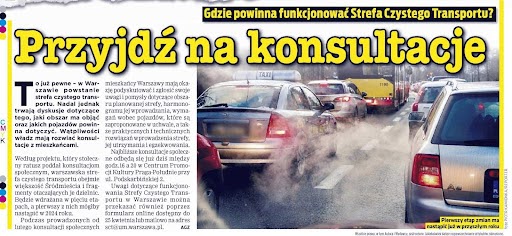
Wycinek z gazety informujący o konsultacjach społecznych w Warszawie

Wnioski, jakie wyciągamy po dwóch latach kampanii na rzecz stref czystego transportu:

  1. Clean-air organizations enjoy relatively high social (and media) trust in Poland, but they often lack the resources to run large campaigns themselves. Combining the forces and reaches of several different organizations and activist groups yields good results.
  2. Local governments often lack the time and resources to conduct effective communication with residents. Many cities are open to using external substantive and expert support, provided they trust the social partners.
  3. Support for green changes in Polish cities reaches 50-70% depending on the proposed solution, but a significant part of the supporting group is the so-called silent majority. Meanwhile, opposition to pro-ecological policy turns out to be good “fuel” for some political forces to build a loud narrative, often utilizing hate and disinformation. To ensure that progressive changes are not halted, the voices of social movements and residents themselves – and not just experts – who support the change must also be heard in the debate around clean transport zones (and related topics).
  4. The media and public opinion are generally less interested in reports and social campaigns, and more in specific government decisions that affect the daily lives of residents. Every such “event” (like the start of public consultations or a debate at a city council session) ignites a wave of discussion. It is good to have information materials prepared in advance, written in simple language, including those that address common human fears and debunk emerging myths.
  5. Media messaging is governed by viewership and click-through rates. Therefore, it is important to create objective information resources regarding planned changes on official municipal and government websites.
  6. False perceptions (both negative and positive) can easily arise regarding unprecedented changes, which are difficult to verify because they concern the future. The fact that similar solutions operate in other countries and we know their effects is not an argument for many people. A factual debate then turns into a conflict of values.
  7. Even a “technical” issue such as conditioning the right to enter a zone based on car emission standards can have a significant socio-cultural context. It is worth thoroughly researching this and keeping it in mind, both when planning solutions and communicating them. The fears and emotions of people who may actually lose out due to the change in regulations cannot be ignored. But first, this group of residents must be well-diagnosed. The next phase of the campaign will therefore focus on better mapping their fears and frustrations and refining clear and honest messages that address these concerns.
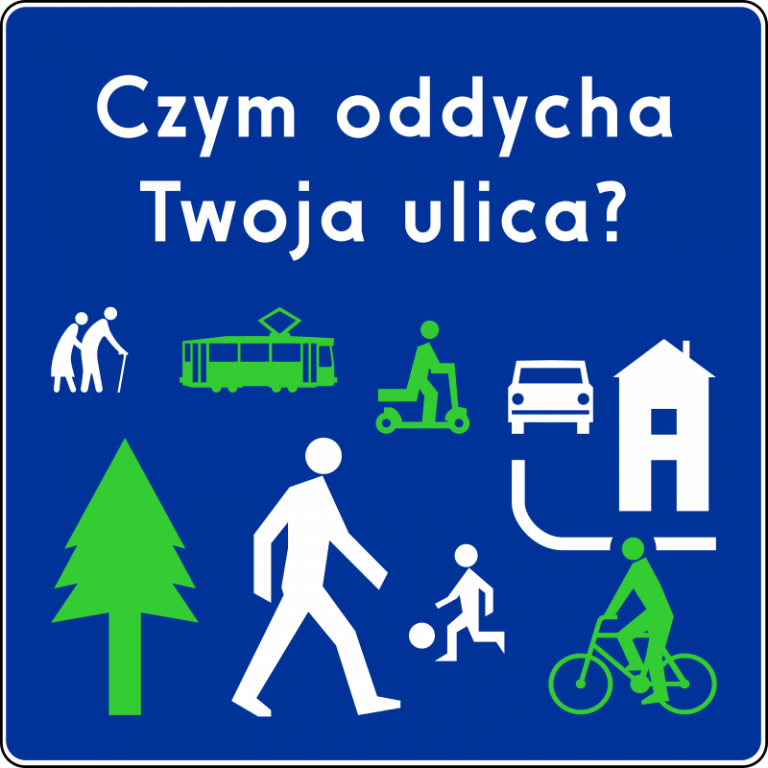
Social campaign – "What does your street breathe?"

Grzegorz Dzięgielewski

Zuzanna Szybisty

Sophie Peck

How to conduct PR abroad?

Case study: How to organize a creative event for journalists?

How much does PR cost?

So what? This is how we do PR for science