How we gained and engaged allies among social organizations and local governments around a controversial topic?
Clean transport zones were and are one of the most controversial topics in the public debate on urban policy and clean air. Local governments and social organizations, despite being aware of the health and environmental benefits, often lacked the communication tools that would allow them to speak out publicly without the risk of escalating the conflict.
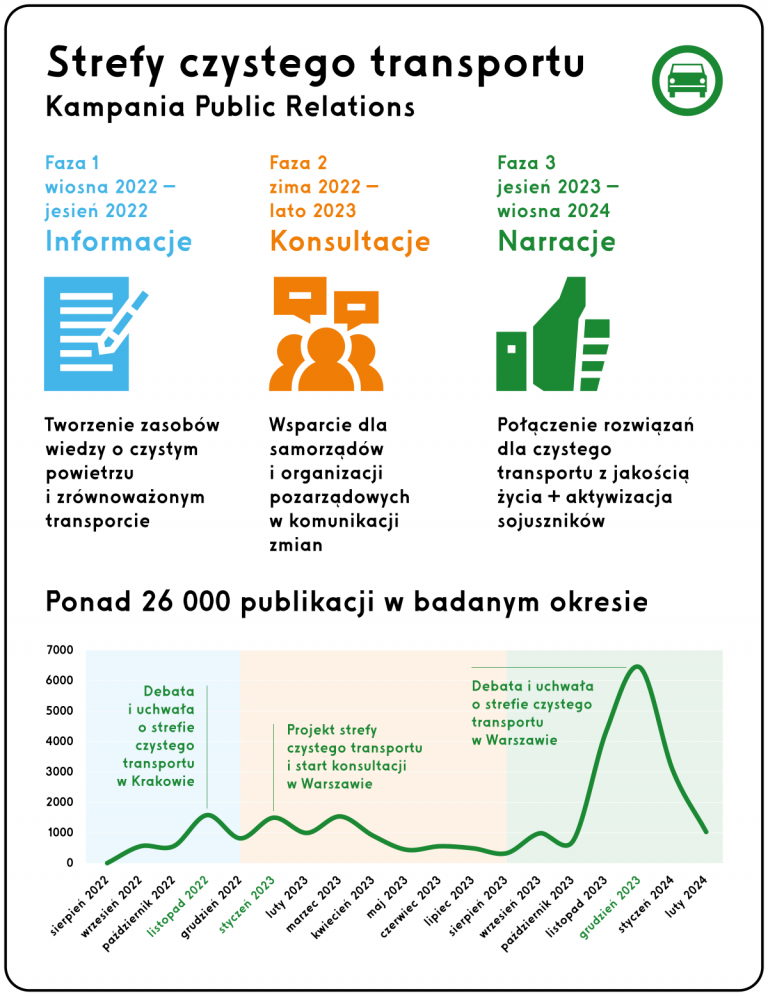
The goal of the PR campaign, implemented by the PR agency Profeina between 2022 and 2025 thanks to a grant from the Clean Air Fund, was to support local governments and social organizations in building a consistent, substantive message and creating conditions to increase social support for clean transport zones in Poland.
1.
Challenge: alliances in a polarized environment
The high level of emotions surrounding clean transport zones made open cooperation between local governments, social organizations, and experts difficult. A key challenge was to create a space for discussion about facts and solutions.
2.
Insight: the need for a shared narrative
An analysis of conversations with partners showed that there was a lack of a shared narrative that would allow local decision-makers and NGOs to communicate CTZs as an element of health policy and quality of life, rather than as a “ban” aimed at residents.
3.
PR activities: strengthening the voice of local leaders
The PR agency Profeina focused its activities on:
PR activities supported dialogue and cooperation instead of confrontation.
4.
Results: new voices in the public debate
Thanks to systematic PR activities, the topic of clean transport zones began to function in the media not only as an element of political dispute but also as a health and systemic issue. In the public debate, the voice of experts, especially from the social side, was strengthened.